KAIROS
AI-Assisted Cognitive Mapping
KAIROS is currently available in French. English localization is in progress.
KAIROS replaces the linear chat with a canvas of connected cards. It measures the vitality of your thinking in real time, and injects friction when ideas start going in circles.
The Problem
When you think with an LLM, a silent dynamic takes over: mutual agreement. The model validates, you nod along, and thought locks itself into a comfort loop.
Friction is not noise to be reduced. It's the engine of emergence. When your ideas look too much alike, KAIROS throws in a question that disrupts — to restart thought.
Before / After
No new idea after 6 exchanges
New line of exploration
The Canvas Replaces the Chat
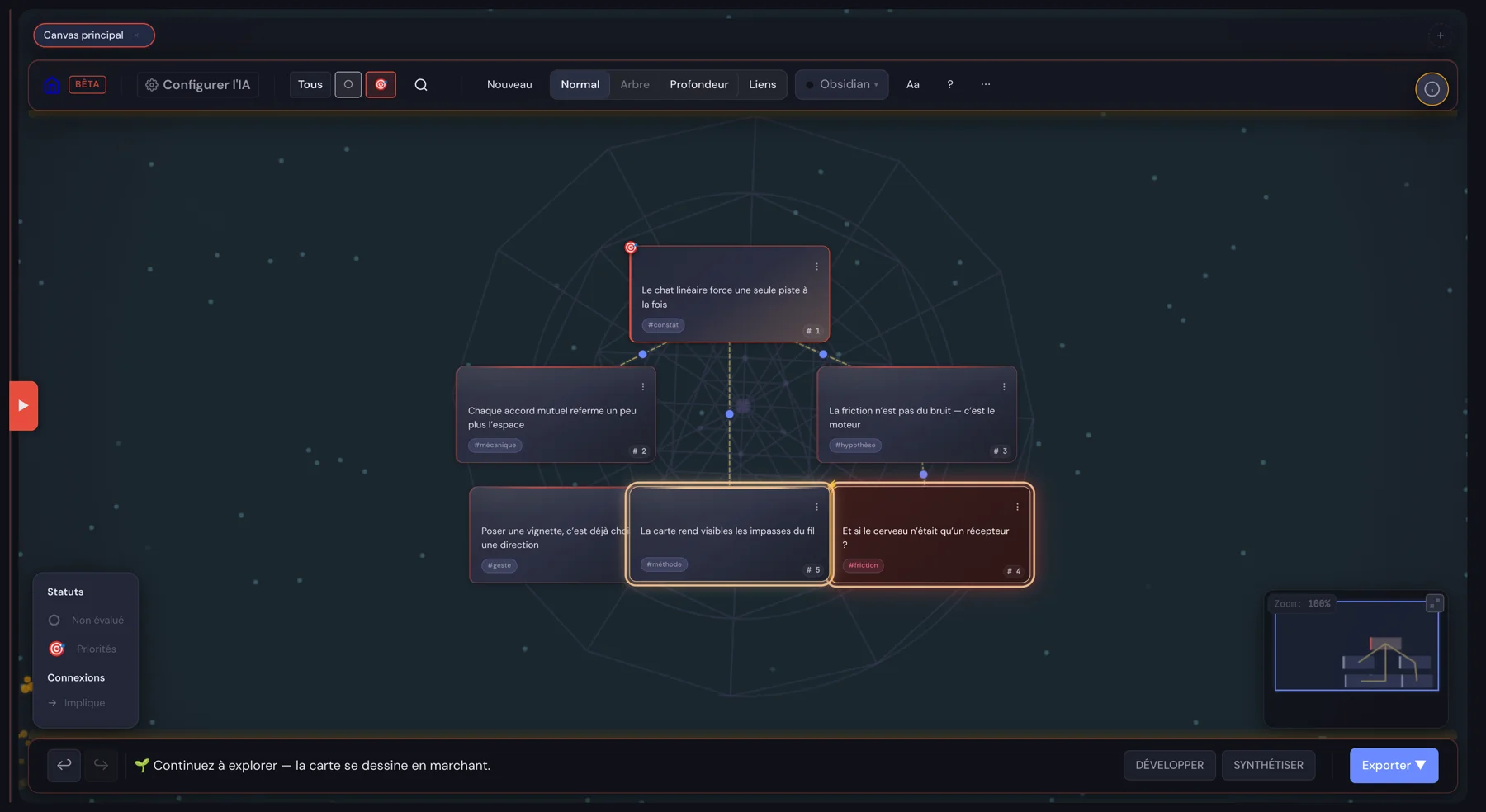
Instead of a scrolling thread of messages, KAIROS lays your ideas on a spatial canvas. Each idea is a card, each link a connection. The result is a thought graph you can explore, rearrange, and structure.
4 Operations, Nothing Hidden
DEVELOP
Generates new cards connected to the existing graph. Two automatic sub-modes: deepen when the graph is open, diverge when it converges too much.
Degressive generation: 3 cards at first, then 2, then just 1 targeted card as the canvas matures. The AI gradually steps back.
CONNECT
Links orphan cards to each other. No new content — only connections. Weaves the graph's structure.
SYNTHESIZE
Structured reading of the graph in 3 blocks: thread (overall narrative), blind spots (under-explored areas), structural question (the question the graph is asking without formulating it).
PERSPECTIVES
Independent convergence analysis. 3 possible scopes: active graph, archived synthesis, or card selection. Produces a thread, action levers, and detected tensions.
Export as editorial HTML document (glassmorphism design, SVG arcs, refined typography).
The Oxygen System
KAIROS measures the cognitive vitality of your canvas in real time. A score from 0 to 100, a 3-axis radar triangle, and automatic intervention when thought starts suffocating.
Structural Signals
The score is calculated around a neutral point of 50, modulated by 3 structural signals and 4 topological metrics.
- Structure — connection/node ratio, detection of disconnected islands
- Friction — recently accepted friction = bonus
- Convergence — bonus if perspectives were generated
- Topology — openness, resolution, propagation, sovereignty
Radar Triangle
3 independent axes from 0 to 100 that measure the balance of your thinking.
- Divergence (ψ) — ratio of nodes with no outgoing chain
- Coherence — longest implication chain in the graph
- Sovereignty — 50% manual nodes + 25% manual connections + 25% edited LLM nodes
Triangle weights are fixed. A punctual « Unfiltered » gesture changes the tone of an exchange, not the score calculation.
3 Zones, 1 Action
The score determines system behavior.
- Breathing (>50) — free exploration, no intervention
- Stalling (30-50) — forces diverge mode
- Suffocating (<30) — automatic friction injection
Content diagnostics: echo, saturation and concentration measured by local embeddings (bge-m3). Informational — they don't modify the score, but a redundant graph can be capped (a saturated canvas won't display 95).
Co-creation
The AI builds on your ideas, not the other way around. KAIROS tracks the origin of every element and measures your ownership of the graph.
Origin Tracking
Every card carries its origin: user, LLM, friction, or import (external source). Cards created manually are tagged [USER] in the LLM context — the AI builds on them instead of rephrasing them.
Cards created since the last LLM cycle are tagged [USER·NEW] and become priority input for the next generation.
Measured Sovereignty
The Sovereignty axis of the radar triangle quantifies your ownership of the graph: nodes you created, connections you drew, and LLM cards you edited to make them yours.
A graph entirely generated by AI will have sovereignty near zero. KAIROS flags it, without forbidding it.
Degressive Generation
As the canvas matures, the AI generates less. At first, DEVELOP proposes 3 cards. Then 2. Then just 1, targeted. The AI fades when thought takes shape.
What KAIROS Does Today
TypeScript, no framework, Electron, embedded SQLite. Everything below is implemented and functional.
Canvas & Visual
4 visual themes
Obsidian (dark, default), Porcelain (light taupe), Aurora (dark blue), Kraft (warm sepia).
Organic SVG connections
Bézier curves with pulsing glow and animated SMIL particles. Implication (green, directional) and resonance (amber, bidirectional).
2.5D depth view
4 depth layers (scale, opacity, blur), mouse parallax, micro-rotation per card.
Dynamic ambient background
Sacred geometry (11 patterns), flow field, audio-reactive. Palette adapts to theme and time of day.
Intelligence
LLM providers
Claude, ChatGPT, DeepSeek, Mistral, Groq, Grok, Ollama. Paste an API key: the provider is detected automatically. Ollama locally, no key. Three models recommended at setup: qwen3:8b (~5 GB), gemma3:4b (~3 GB), qwen3:14b (~9 GB).
Structured syntheses
3 blocks: thread (narrative), blind spots (under-explored), structural question. Cards archived and repositioned.
Smart placement
Cards generated by DEVELOP are positioned near their connection target, not stacked at the bottom of the canvas.
Visual prompt log
History of every LLM interaction. System prompt / user prompt separation. Import indicators per card (✓ accepted / – ignored).
Workspace
Multi-canvas tabs
Browser-style tab bar (Ctrl+T / Ctrl+W). Each canvas has its own LLM provider and model. Provider badge on each tab.
Ambient audio player
Integrated audio visualization + web radio mode (7 stations). Audio-reactive ambient background.
Full onboarding
9 full-screen slides, ephemeral demo canvas, 5 contextual coach marks. Built-in LLM setup wizard.
Security & robustness
SQLite backups every 30 min + on quit. Error boundaries, persistent logs, API key validation on startup.
Modes & recent features
Guardian mode
Cognitive safety net: detects at-risk patterns in exchanges and keeps an observation log. A net, not a control.
Companion
A free chat, independent of the canvas: a complementary dialogue space to clarify an idea on the fly without structuring the graph. Optional web search.
External source import
Files, PDFs, URLs: KAIROS summarises them and injects them as cards into the canvas, ready to be developed or linked.
KAIROS in Pictures
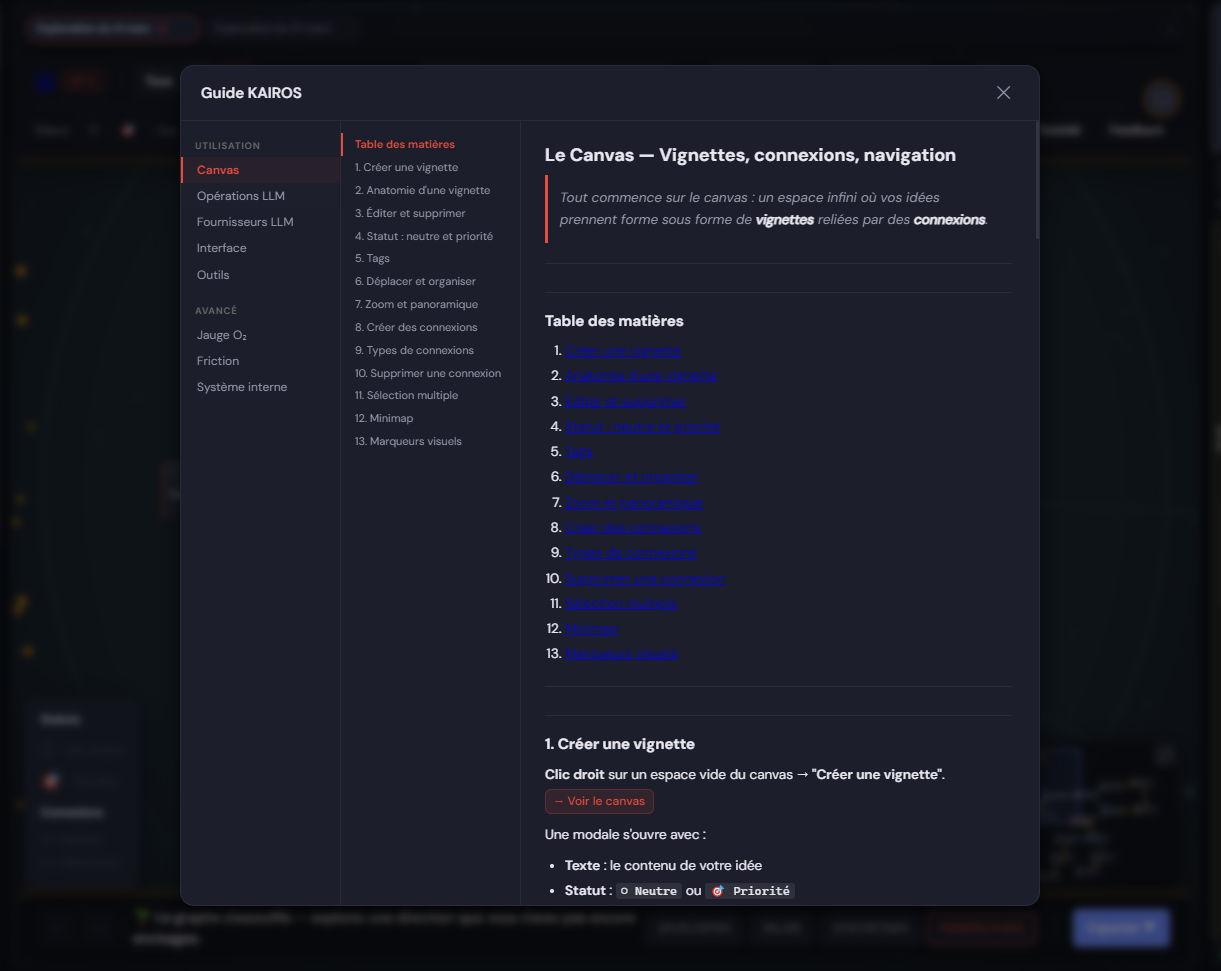
A few views of the application.
Theoretical Foundations
KAIROS builds on academic work in conversation analysis, cognitive psychology, and pragmatic linguistics.
Repair Sequences
Conversational repair detects and resolves comprehension breakdowns. KAIROS uses these markers to identify moments of productive friction.
Socio-Cognitive Conflict
Conflict between different perspectives stimulates learning and cognitive development. Friction is not an obstacle but an engine.
Discourse Markers
Discourse markers signal relationships between utterances. "But", "however", "actually" indicate productive friction.
Conflict Regulation
Epistemic regulation (productive) vs. competitive (parasitic). KAIROS distinguishes friction that advances from friction that blocks.
The Resonance Equation
The theoretical model behind KAIROS. Resonance emerges when intention and friction combine against linearization.
The Cognitive Engine
Watch KAIROS's core mechanism: the O₂ gauge measures cognitive diversity. When ideas converge too much, friction is injected to restart thought.
How it works
+ Card — add ideas to the canvas
DEVELOP — generates connected ideas
CONNECT — links orphan cards
SYNTHESIZE — structured reading of the graph
O₂ = cognitive vitality. When it drops below 30, KAIROS injects friction to break convergence.
Journal
Explore the Canvas
Create cards, launch DEVELOP to generate ideas, use CONNECT to link your thinking — all directly in your browser, no API key, no install.
Who Is It For?
KAIROS is for people who use LLMs to think, not just to produce.
Researchers
Explore hypotheses without falling into confirmation bias
Creatives
Brainstorm without circling the same ideas
Philosophers
Push a line of thought beyond comfortable agreement
Students
Learn to structure thinking and detect blind spots
Project leads
Map a complex problem, identify dependencies
Writers
Prepare a thesis, dissertation, or structured argument
Go further
Internal application docs are not mirrored here. Two public texts describe the frame and the architecture (in French).
Technical overview
Architecture, Oxygen gauge, friction, radar triangle. The bridge between L'Entre and the software.
Genesis of KAIROS
From theoretical impossibility to a concrete build: why the canvas replaced the chat.